
Overview
What Is "Annabel Lee" About?
What Is Annabel Lee About? This analysis delves into the profound meaning embedded within this sorrowful tale of love, the influences that
Read —>A love that the angels themselves envied — and that not even death could undo. Read Poe’s final masterpiece, then wander its meaning.
To truly appreciate “Annabel Lee” by Edgar Allan Poe, it’s essential to dive into the context and background surrounding this hauntingly beautiful poem.
“Annabel Lee” was published in 1849, the same year as Poe’s death. It is considered his last complete poem, appearing posthumously in the New York Tribune and leaving a lasting mark on the world of literature.
This was a time when romanticism and gothic themes were prevalent in American literature, and Poe’s work fit perfectly into this literary landscape.

Edgar Allan Poe’s personal life was marked by tragedy and hardship. He faced the loss of loved ones, struggled with financial difficulties, and battled with alcoholism.
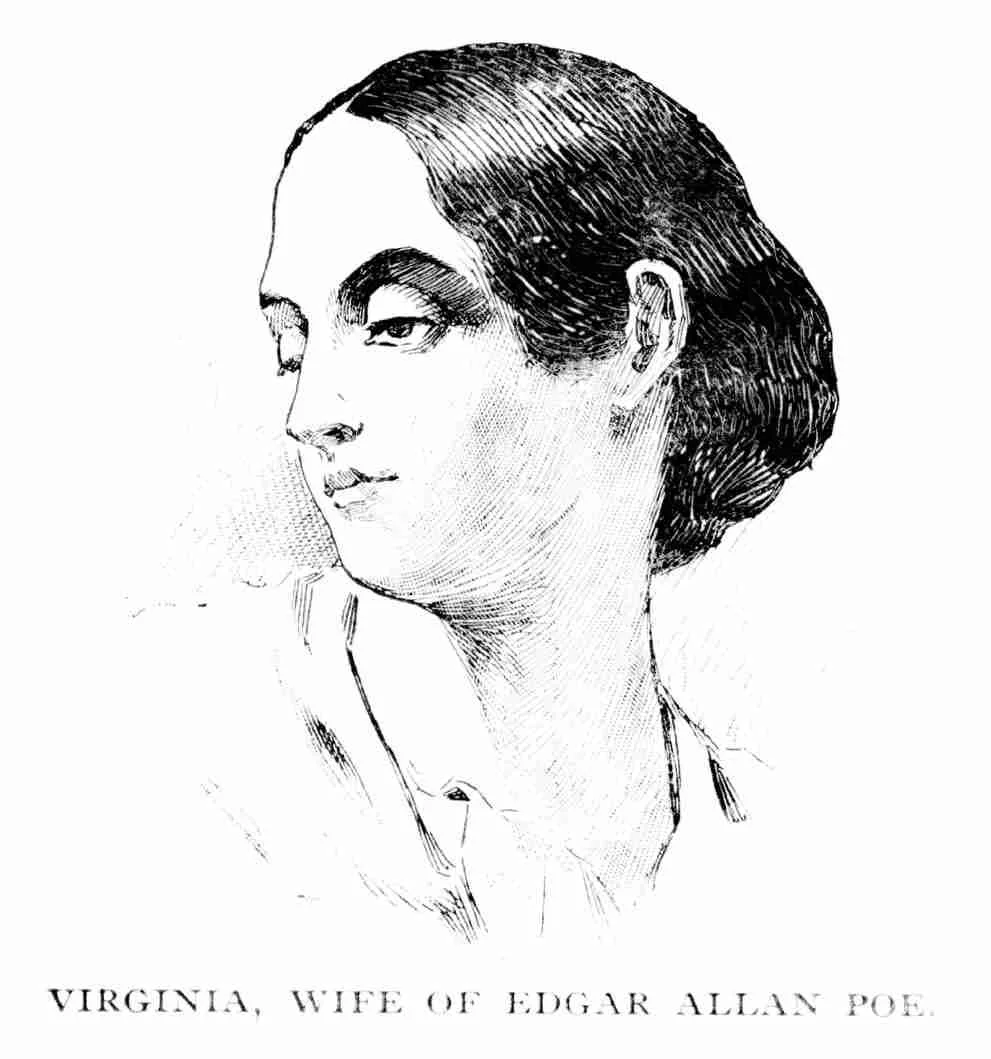
However, one of the most significant influences on “Annabel Lee” was the death of his young wife, Virginia Clemm, in 1847. Heaven coveted the love between Poe and Virginia, leading to tragic events that deeply affected him.
Virginia’s passing, at the tender age of 24, left Poe devastated. It’s believed that her death inspired the themes of love and premature death that permeate the poem. Their marriage was marked by deep emotional connection, despite societal criticism due to their close familial relation and Virginia’s young age at the time of their marriage.
Their relationship was likely met with scrutiny and disapproval. Virginia was Poe’s first cousin and only 13 when they married, while Poe was 27. This age gap and familial relation would have been controversial, prompting Poe to assert the purity and depth of their love in his writing.
Line 15 reads: “A wind blew out of a cloud chilling my beautiful Annabel Lee.” In this context, the “wind” might symbolize the unforeseen and uncontrollable forces that impacted Poe’s life, particularly the illnesses that afflicted his loved ones.
Specifically, it could represent the tuberculosis that claimed the life of his wife, Virginia. Tuberculosis, often referred to as “consumption” in Poe’s time, was a widespread and feared disease that could strike suddenly and lethally, much like a chilling wind. Neither the angels in heaven nor the demons under the sea could ever dissever Poe’s soul from the soul of his beautiful Annabel Lee.
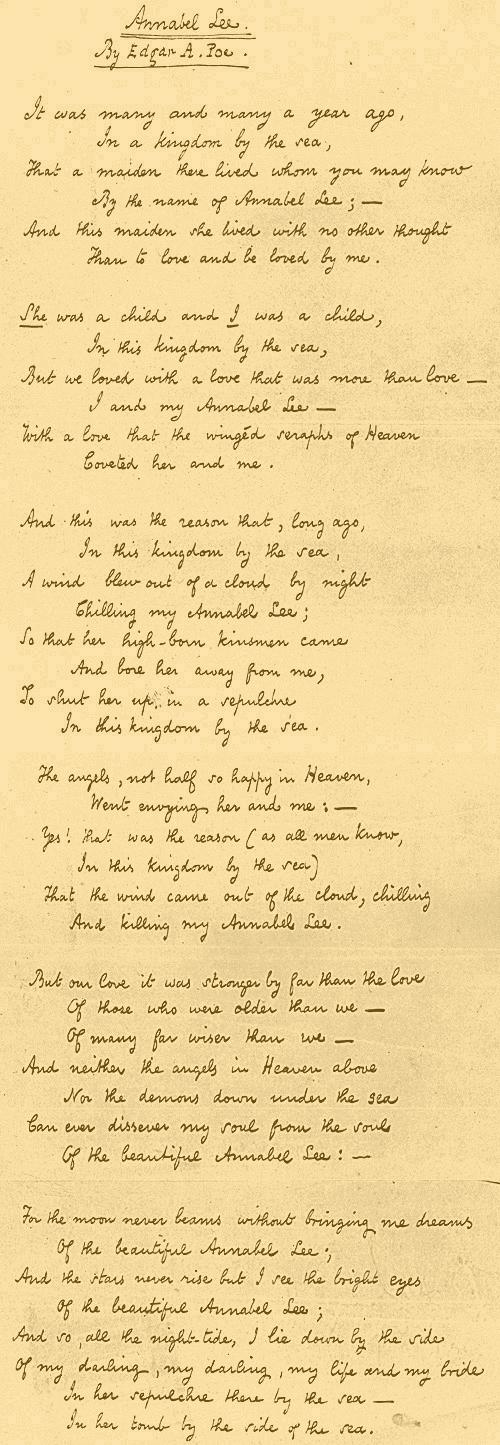
One of the most prominent symbols in the poem is the “kingdom by the sea.” This kingdom represents the idyllic world that the narrator and Annabel Lee inhabited—a world characterized by their pure and innocent love. It serves as a symbol of their happiness and the paradise they shared. Long ago, in this kingdom by the sea, the wind blew out of a cloud, chilling Annabel Lee.
Death and the supernatural are recurring themes in the poem, and Poe employs vivid imagery to convey these concepts. The imagery related to death, such as “chilling and killing,” “sepulchre there by the sea,” and “sounding sea,” creates a sense of foreboding and melancholy.
The supernatural elements, including angels and demons, add an eerie and mystical dimension to the narrative. The presence of the “seraphs” who envied the narrator’s love and the “wingèd seraphs of heaven” who disapproved of their union introduces an otherworldly quality to the poem.
This supernatural aspect enhances the theme of love transcending death, suggesting that their love was so powerful that even celestial beings took notice. The speaker lies down by the side of his beloved in her sepulchre by the sea, even during the night tide.
“Annabel Lee” not only stands as a tribute to Poe’s love for Virginia but also reflects his obsession with the theme of death, which was a recurring motif in his works.
Many readers consider “Annabel Lee” their favorite poem, admiring its emotional depth and haunting beauty.
The poem’s portrayal of the enduring love between the narrator and Annabel Lee, despite death’s attempts to tear them apart, showcases the depth of Poe’s emotions and his fascination with the supernatural. It remains one of the favorite poems for its timeless appeal and emotional resonance.
“Annabel Lee” is a hauntingly beautiful narrative poem that tells the story of a young couple deeply in love. Their love, however, faces the jealousy and envy of the angels in heaven, leading to a tragic and untimely separation.
It is often regarded as a great poem, admired for its emotional depth and captivating narrative.
It has captivated readers for generations with its lyrical and musical quality. It has been adapted into various art forms, including music, film, and literature.
Poe’s masterpiece has left an indelible mark on the world of poetry and continues to inspire writers, musicians, and artists to this day. Its themes of love, death, and the supernatural resonate with audiences, making it a great story and a timeless classic.
When we think of Poe and lost love, “Annabel Lee” stands out as a poignant example. In comparison to his other works centered on lost love, such as “Lenore” and “The Raven,” “Annabel Lee” is unique in its portrayal of love as a force that not only lingers but also prevails in the face of death.
While Poe’s other works often emphasize the agony of lost love, “Annabel Lee” offers a glimmer of hope and eternal reunion, making it a standout in his oeuvre.
The poem vividly portrays the overwhelming sense of loss and the profound grief that follows Annabel Lee’s death. This theme resonates with anyone who has experienced the pain of losing a loved one and captures the universal emotions associated with bereavement.
The symbolism of Annabel Lee’s death is equally impactful. Her death is not merely a tragic event in the poem; it’s a symbol of the cruel and arbitrary nature of death itself.
The fact that she is taken by the “angels” due to “envy” highlights the fragility of life and the unpredictability of fate. This theme serves as a powerful reminder of the impermanence of existence and the capriciousness of mortality.
The poem is composed of six stanzas, each containing six lines. This structured consistency lends a sense of rhythm and musicality to the poem, echoing the waves of the sea that feature prominently in the narrative.
Edgar Allan Poe, one of my favorite poets, has crafted a masterpiece with “Annabel Lee” that continues to resonate with readers.
The opening lines of Poe’s “Annabel Lee” are like a magic spell, drawing you into a world that’s just out of reach. “It was many and many a year ago, In a kingdom by the sea,” – these words aren’t just setting the scene; they’re weaving a tapestry of a place and time that’s tantalizingly distant.
I’m struck by how this poem has left an indelible mark on literature, popular media, and the broader artistic landscape. “Annabel Lee” has inspired countless writers and poets over the years. Its themes of love, loss, and the supernatural have become enduring motifs in literature.
Poe’s mastery of evocative language and storytelling has established a formidable benchmark for aspiring writers. Numerous authors have been deeply inspired by his literary contributions, infusing facets of his distinctive style and thematic elements into their own artistic endeavors.
The impact is far-reaching, with notable examples including Rainbow Rowell’s “Eleanor & Park,” the works of China Miéville, the creative expressions of artists like Stevie Nicks and Nathalie Merchant, as well as the evocative illustrations of Gustave Doré, among others.
My journey through the world of Edgar Allan Poe’s “Annabel Lee” has been a fascinating exploration of love, loss, and the enduring power of poetry. Poe’s lasting legacy and the continued relevance of “Annabel Lee” are undeniable. His impact on the world of literature and art endures, as his works continue to be studied, adapted, and appreciated.
Think about it. This isn’t the kind of love you come across every day. It’s the kind that stays with you, buried deep in your heart, a constant, warm presence that you know you’ll never get to touch or embrace again. It’s right there, yet so far out of reach. It’s the love that you carry within, a burning flame that never dies, no matter how much the wind howls or the storms rage.
“Annabel Lee” is a testament to the enduring power of poetry to touch our hearts and souls. It reminds us that even in the face of death and despair, love can shine brightly like a star in the night sky.
In closing, I invite you to embark on your own exploration of “Annabel Lee.” Dive into its verses, let its beauty wash over you, and discover the timeless allure of Poe’s poetic masterpiece. Just as I have been enriched by this journey, I hope you too will find solace and inspiration in the words of “Annabel Lee.”
Sixteen close readings — its themes, its symbols, and the mystery that ties Annabel Lee to the House of Usher.
What Is Annabel Lee About? This analysis delves into the profound meaning embedded within this sorrowful tale of love, the influences that
Read —>
Annabel Lee Summary. "Annabel Lee" is a hauntingly beautiful poem written by Edgar Allan Poe, diving into themes of love, loss, and the afterlife
Read —>
Annabel Lee Meaning. The true identity of the enigmatic figure known as Annabel Lee and the narrative behind the renowned poem by Edgar Alla
Read —>
Theme of Annabel Lee. Delve into the intricately crafted world of Edgar Allan Poe's poem "Annabel Lee" to explore its themes, symbols, and struc
Read —>Symbolism in Annabel Lee. The analysis will delve into the various symbols employed in the poem, such as the sea, the moon, the angels, and the
Read —>
Annabel Lee Analysis: A comprehensive examination of Edgar Allan Poe's "Annabel Lee" uncovers a complex array of themes, symbolism, and
Read —>A clean, printable edition of “Annabel Lee” — perfect for the classroom, the commonplace book, or a quiet evening.
Download the PDF